Medical Dermatology
When a rash keeps coming back and no one can tell you why, the cause is often something you touch every day. Comprehensive patch testing pinpoints the specific allergens responsible, so treatment can finally target the source instead of the symptoms.
We test using the North American Standard 80 Comprehensive panel, which screens for 80 of the most clinically relevant contact allergens. It covers the preservatives, fragrances, metals, topical medications, rubber additives, and adhesives responsible for the large majority of allergic contact dermatitis.
This breadth matters. It gives the panel a strong likelihood of capturing the substance behind a persistent rash, which is what makes the results actionable rather than inconclusive.
Our trained clinical staff applies and maps the patches, and Dr. Yamany sees you at that same visit. Every reading and interpretation is performed by a board-certified dermatologist. Interpretation is the part that determines whether testing actually helps: distinguishing a true allergic reaction from simple irritation, and translating each positive result into practical, specific guidance about what to avoid.
Testing is most valuable when a rash is persistent, recurrent, or has not responded to standard treatment.
Contact allergens hide in ordinary products. These are among the most common categories we identify.
Common hidden triggers found in skincare, cosmetics, shampoos, and household products, including formaldehyde releasers and fragrance mixes.
Nickel, cobalt, and gold are frequent causes of persistent rashes from jewelry, belt buckles, eyeglass frames, and dental or orthopedic hardware.
Ingredients in prescription and over-the-counter creams, including corticosteroids and antibiotics, that can paradoxically worsen a rash.
Accelerators in gloves, elastic waistbands, and shoes, plus adhesives found in medical tapes and bandages.
Dyes, acrylates in gel manicures, and other salon-related allergens that commonly affect the face, eyelids, and hands.
The panel includes many allergens encountered at work, which often matters for healthcare workers, hairstylists, food handlers, and the construction trades.
Testing is scheduled across a single week — Tuesday, Thursday, and Friday. Understanding the schedule up front helps you plan around it.
Tuesday
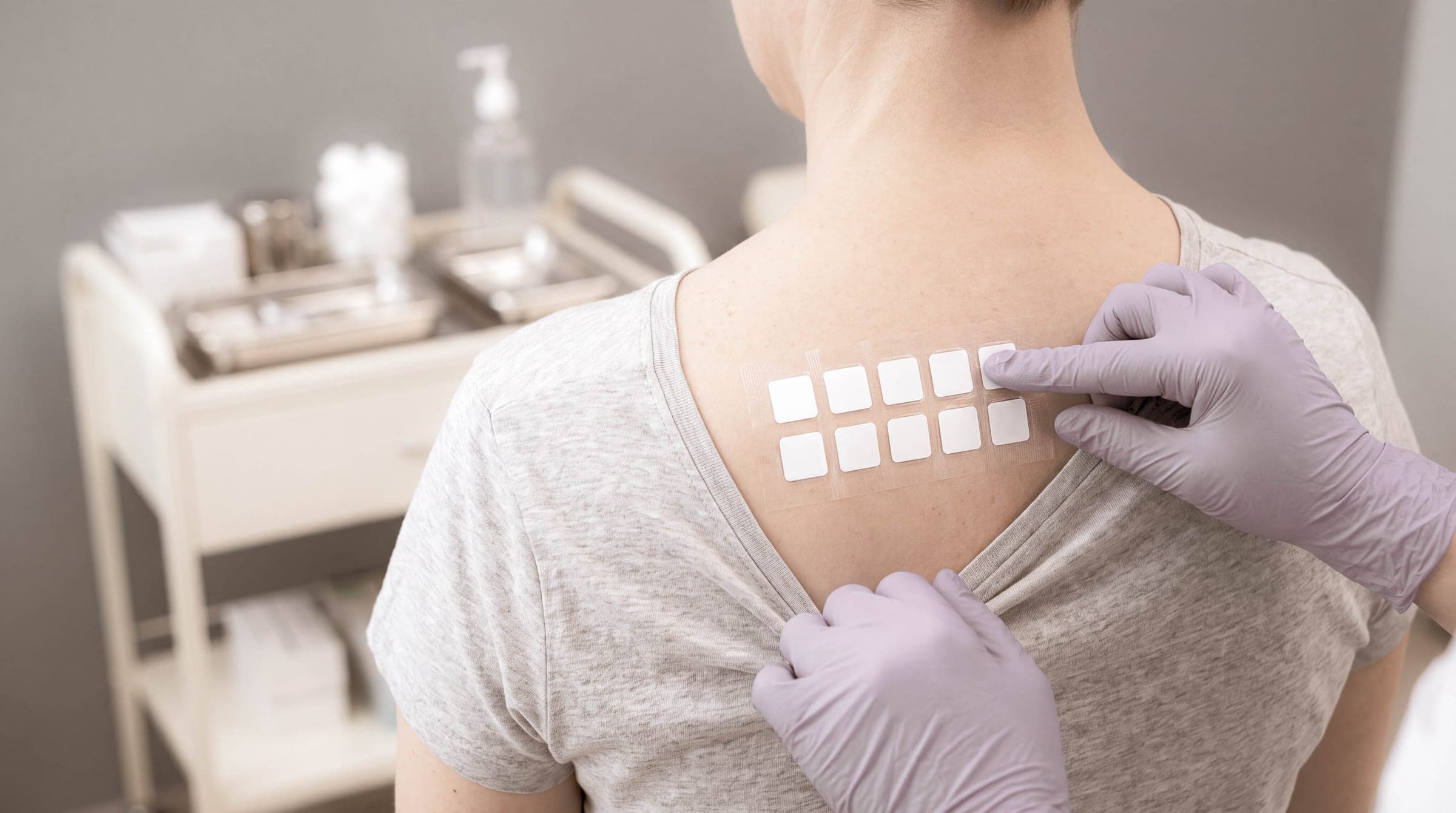
The allergen patches are applied to your upper back and mapped precisely. This visit typically takes 30 to 45 minutes.
Thursday
The patches are removed after 48 hours and the sites are examined and documented. Some reactions are visible at this stage, but the test is not yet complete.
Friday
The most important reading. Many true allergic reactions only appear at this point, which is why the final visit cannot be skipped. We review your results and avoidance plan the same day.
The patches must stay completely dry from Tuesday until they come off Thursday, which means no showering, swimming, or heavy sweating during that window. The Friday reading is what makes the test conclusive, so we ask that you schedule when you can commit to the full sequence. Review the preparation instructions before your first appointment.
We welcome referrals from dermatologists, allergists, primary care physicians, and occupational health providers for patients requiring comprehensive patch testing. We are happy to accept patients for testing and interpretation only, and return them to your care with full documentation.
All patients are tested with the North American Standard 80 Comprehensive panel.
Detailed results with clinical relevance assessment and a patient avoidance list.
Patients can be returned to your practice for ongoing management after testing.
They test two entirely different immune responses. Prick testing, usually performed by an allergist, looks for immediate Type I reactions such as hives, food allergies, and hay fever, and results appear within minutes. Patch testing identifies delayed Type IV hypersensitivity, the mechanism behind allergic contact dermatitis, which takes days to develop. Because of this, antihistamines do not interfere with patch testing.
Three, scheduled within a single week. Patches are applied on Tuesday, removed and read for the first time on Thursday, and read a final time on Friday. Delayed hypersensitivity reactions develop over several days, so the Friday reading is the most diagnostically valuable, since many genuine allergies are not yet visible on Thursday. Completing all three visits is essential for accurate results.
The application itself is painless. If you are allergic to one of the substances tested, that specific site may become itchy or develop a small patch of irritation, which is the expected positive result. Any discomfort is typically mild and resolves within days.
The patches must stay completely dry while in place, so you will need to avoid showering, swimming, and any activity that causes significant sweating until they are removed. Sponge baths that avoid the back are fine.
Oral steroids and certain immunosuppressants can suppress reactions and produce false negative results, so these often need to be paused before testing. Topical steroids should not be applied to the test area. Never stop a prescribed medication without checking with us or your prescribing physician first. Antihistamines do not need to be stopped.
Patch testing is a diagnostic medical procedure, not a cosmetic service, and is typically covered by insurance when medically indicated. Your standard copays, coinsurance, and deductible may apply. We recommend verifying coverage with your plan before your appointment.
Identifying an allergen is only useful if you can avoid it. We review each positive result with you, explain which product categories and ingredient names to watch for, provide a personalized avoidance list, and build a treatment plan to clear the existing rash.